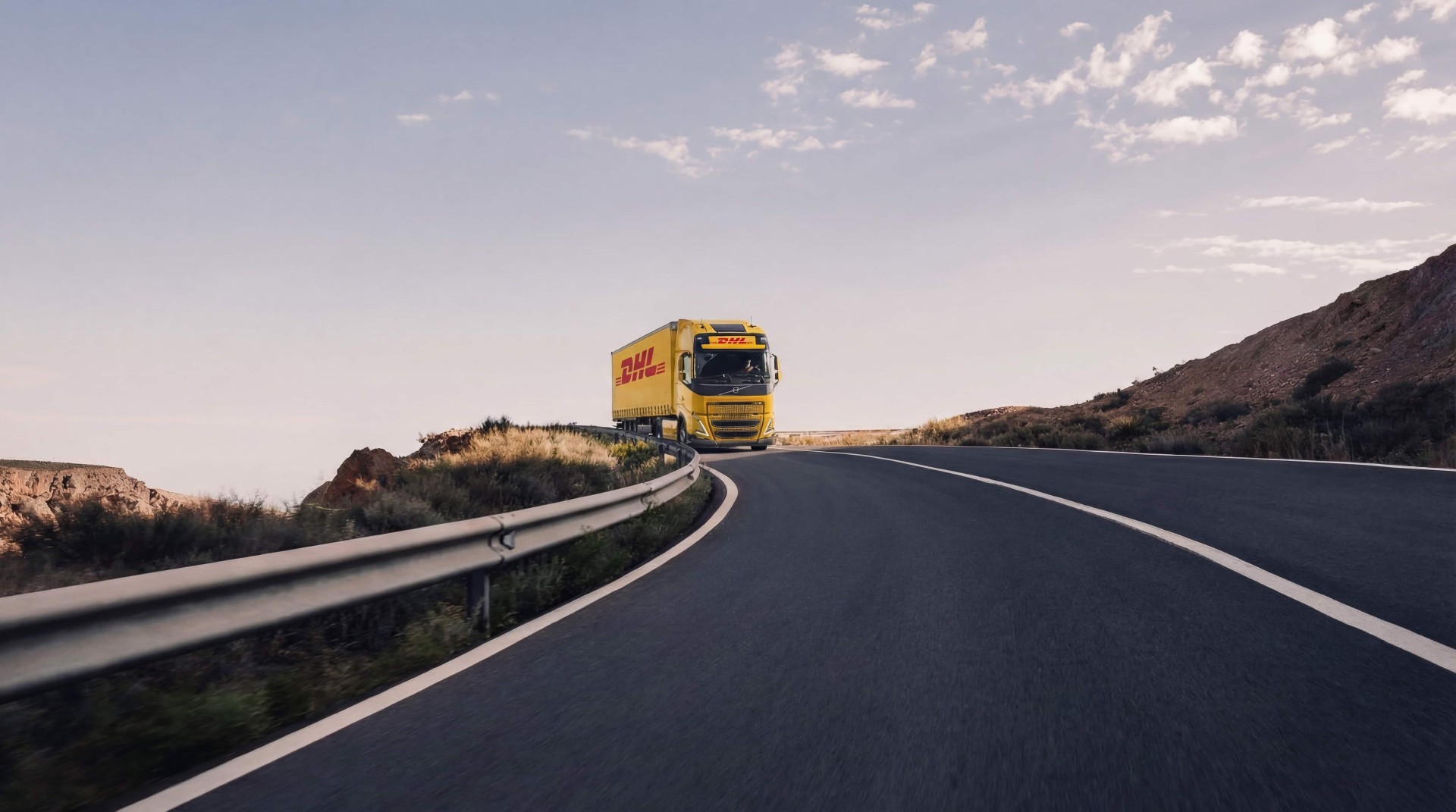

Over 4% fewer
kilometres across
the network.
How DHL replaced route-by-route planning with a network-level optimisation engine that cuts distance and cost without touching the service promise.
The problem.
Planners were configuring a multi-country network from spreadsheets, experience and static systems, where every route could be optimised on its own but the network as a whole could not.
Optimising every route is not the same as optimising the network.
DHL's road logistics network spans lanes, hubs and assets across several countries, and growth meant more trucks, more kilometres and more emissions. Planning tools focused on individual routes, so cross-network opportunities were invisible: where to reload, which flows to combine, which equipment to reconfigure. Empty runs and sub-optimal loading quietly eroded margins and made environmental targets harder to meet.
None of it arrived as a single failure. It accumulated lane by lane, and solving it lane by lane was no longer realistic.
The prototype.
Historical shipment data, fleet and asset information, locations and constraints were assembled into a unified data model, then used to test whether network-level optimisation could outperform manual planning.
The engine evaluated all equipment and routes at once, simulating alternative loadings, switch points and combinations through machine learning and mathematical optimisation. Early experiments found non-obvious combinations that reduced total distance while preserving customer commitments. The service promise was treated as a constraint, not a variable.
In production.
Fast Trek runs as a machine learning optimisation layer inside the operational platform DHL planners already use, fed by order volumes, lanes, time windows, asset availability and operational constraints.
It continuously searches for better network configurations, reallocating trailers, suggesting load consolidations and resequencing routes within practical limits.
The interface was designed with DHL planners, so complex optimisation output arrives as clear suggestions rather than opaque model results. Planners test scenarios, apply changes and track impact without disrupting the underlying transport management and ERP systems.
The engine does the searching and the planner keeps the decision, which is what makes the suggestions trusted enough to act on.
“Through Fast Trek, we unlock the potential of data and route analysis, driving efficiency and delivering operational excellence.”

















Change how
you operate.
Tell us where you’re stuck. If operational AI can change the outcome we’ll show you how, and if it can’t, we’ll say so.
Talk to us